

Water
Calcium nodules on pool plaster
Why white bumps grow out of cracks and loose plaster, how to tell them from scale, and when a patch is enough.
Article
Liquid chlorine adds no stabilizer and no calcium, which suits hard LA water. Here is how to work out the dose from the label, when to pour it, and how to keep a jug from going flat.
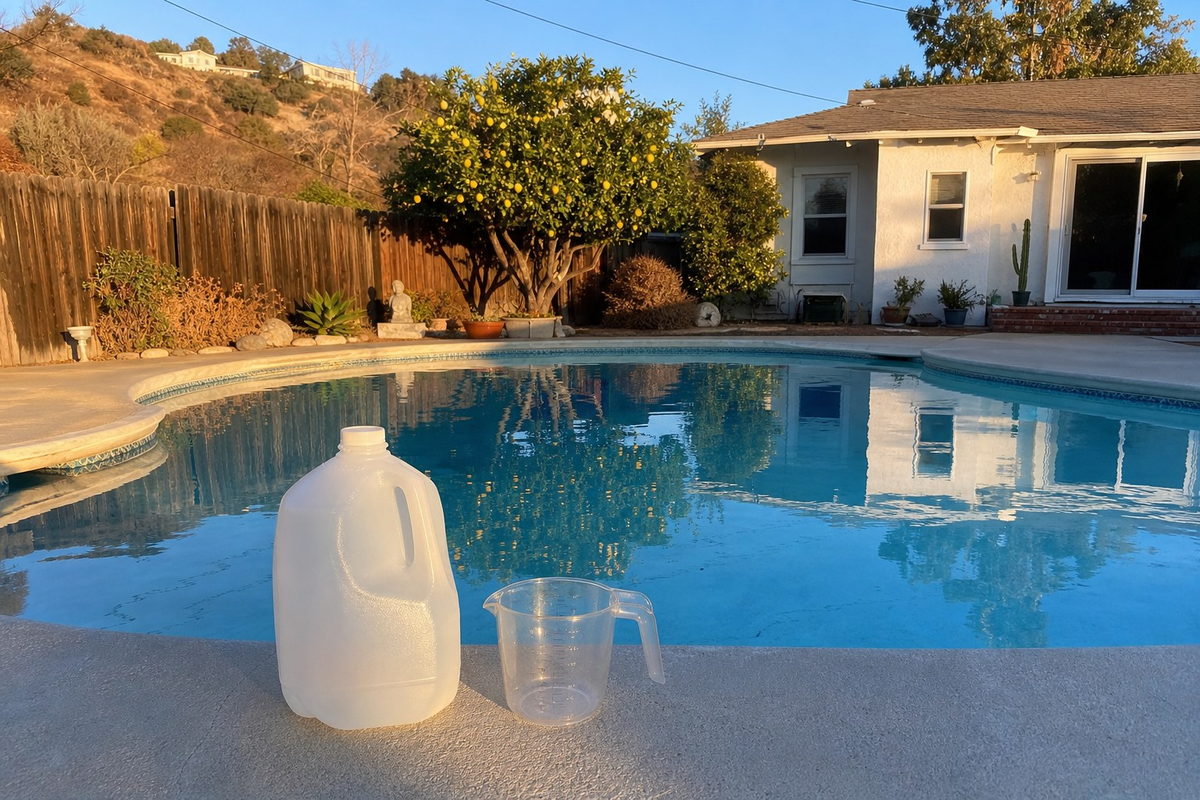
Liquid chlorine is sodium hypochlorite in water, the same chemical as household bleach but stronger: pool-grade jugs run 10–12.5%. It works the moment it hits the water, there is nothing to dissolve, and it leaves nothing behind except a little salt.
Every kind of chlorine does the same job. What differs is what comes along with it, and in Los Angeles, where tap water already brings plenty of minerals, that decides which one stays in the shed.
The stabilizer side of that list has its own page, the cyanuric acid guide. If tablets have pushed yours too high, liquid chlorine is the usual way to stop feeding it.
The dose is arithmetic, and the label strength is the input. One gallon of 10% liquid chlorine raises free chlorine by about 10 ppm in 10,000 gallons of water. A 12.5% jug raises it by about 12.5 ppm. So to add 1 ppm per 10,000 gallons you need roughly 13 fluid ounces of 10% product, or about 10 ounces of 12.5%.
Take a 15,000-gallon pool with a 12.5% jug and a goal of raising chlorine by 3 ppm: 3 × 10 ounces × 1.5 comes to about 45 ounces, a little over a third of a gallon. Where the reading should end up is on the pool chemistry page: 1–3 ppm for most pools. The doses for a green pool are higher and depend on the colour of the water, and they sit on the green pool page.
Not sure of your volume? Length × width × average depth × 7.5 gives gallons, close enough for dosing. A jug that has sat for months is weaker than its label, so test after the dose and add more only if the reading says so.
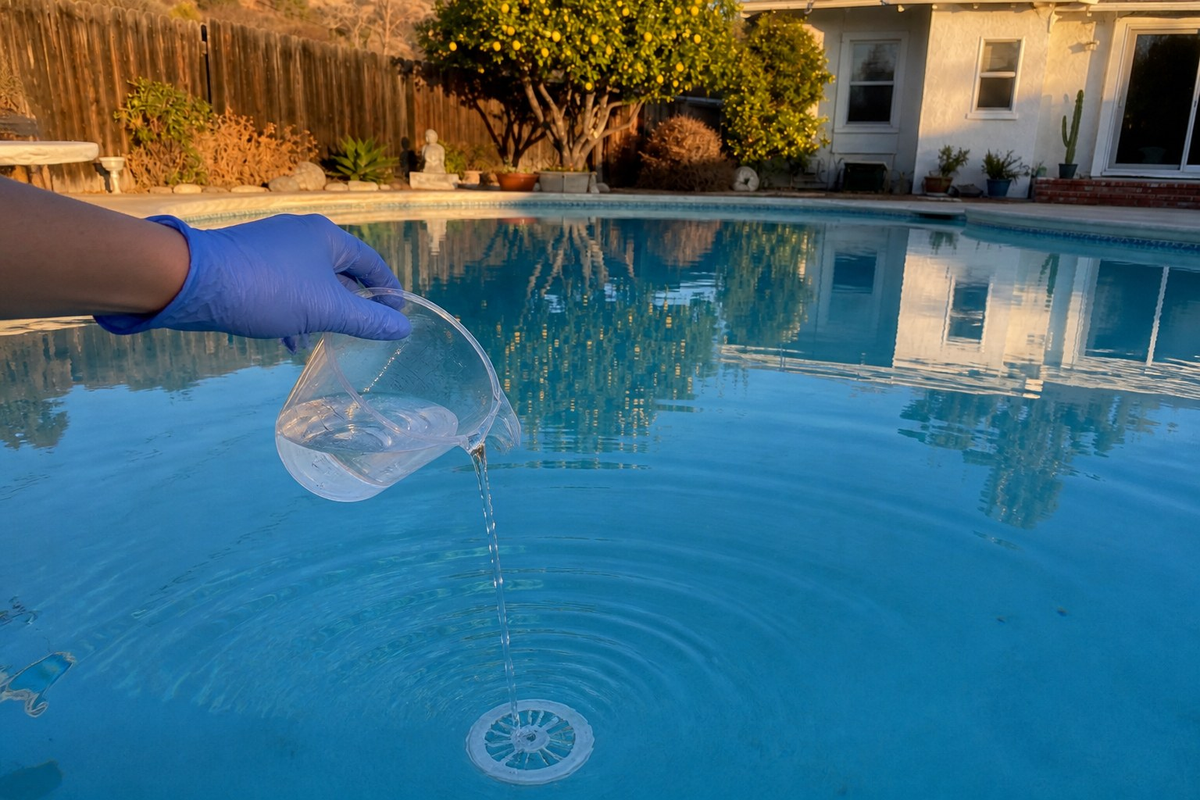
Liquid chlorine carries no stabilizer, so strong sunlight breaks it down quickly. A pool with no stabilizer at all can lose most of a dose within a couple of hours of afternoon sun. That is why the same pool needs a little stabilizer in the water, within the range on the stabilizer page, and why liquid chlorine goes in after sunset.
It also raises pH slightly with each dose. If you pour often, test pH once a week and see the alkalinity and pH guide when it creeps up.
Buy plain sodium hypochlorite, 10–12.5%, from a pool store or a hardware store. Skip anything scented, thickened or sold as splashless bleach: the additives are made for laundry, not for water you swim in. Household bleach is weaker, and you would pour a lot more of it.
The product loses strength with age, heat and light. A garage in a Valley August is the worst place for it. Buy what you will use in a few weeks, keep it upright in a cool shaded corner, and use the oldest jug first.
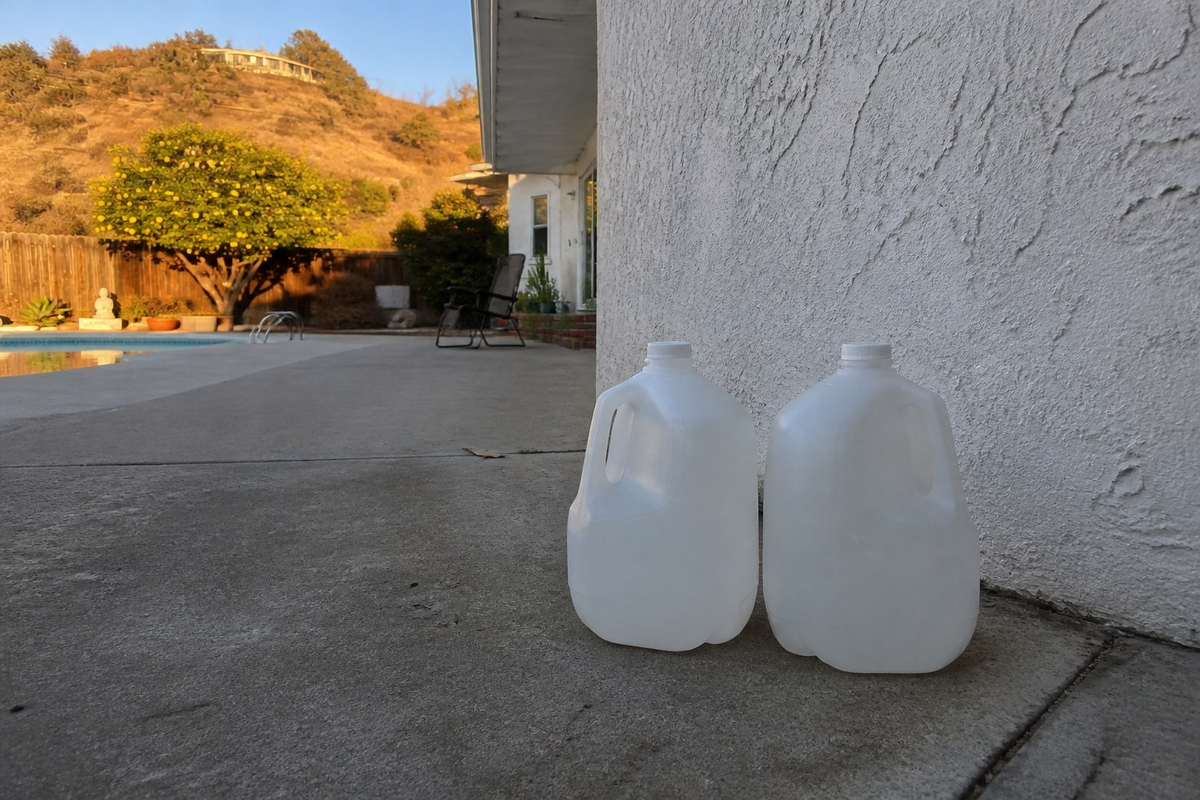
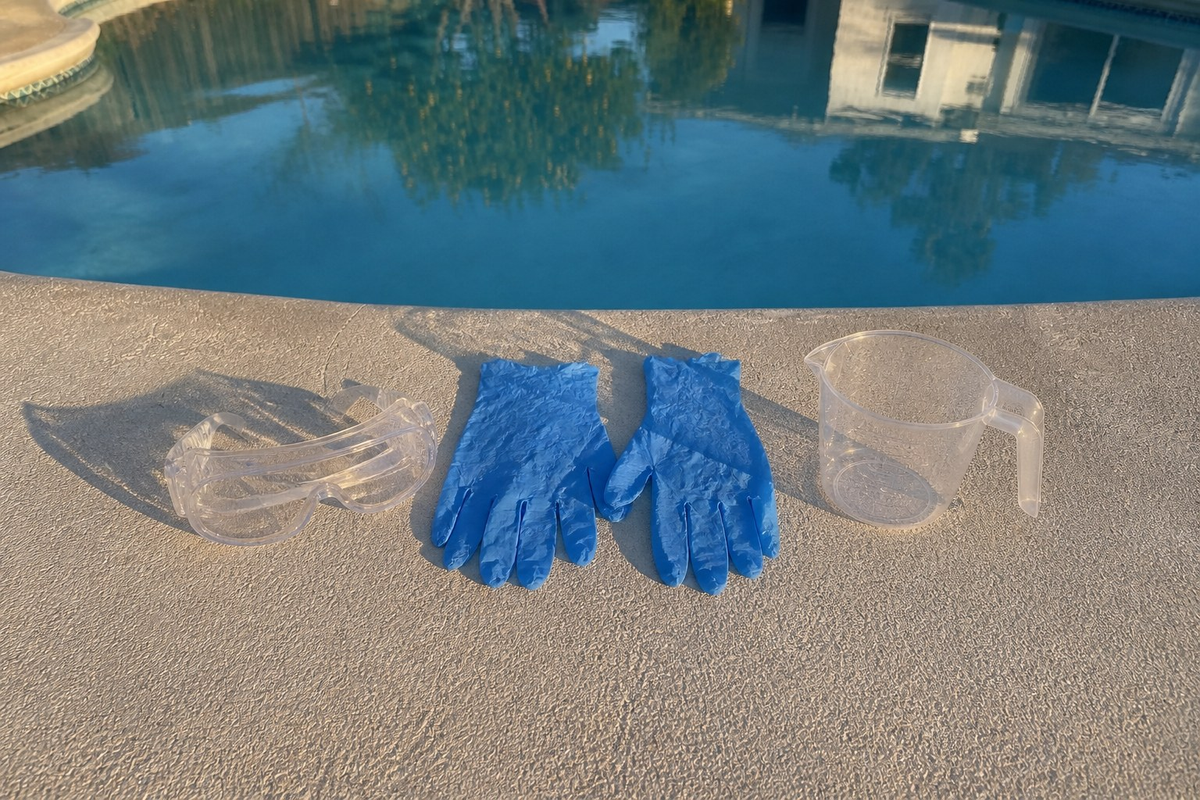
Never mix liquid chlorine with acid, with another chlorine product or with a cleaner: the mixture gives off chlorine gas. Keep jugs where children and pets cannot reach them, add chlorine to water and not the other way round, and rinse splashes off skin right away.
It keeps a clear pool clear. It does not turn a green one back by itself: brush, balance and shock in rounds, which the green pool page lays out. Yellow dust on the walls needs a different approach, see the mustard algae page, and a salt pool makes its own chlorine, so the saltwater maintenance page covers when a jug is needed at all.
Doing it yourself, you pay the store's price for each jug, and that price is the store's, not ours. How many jugs you need depends on pool volume, sun and how much stabilizer is in the water.
A weekly visit begins with a chlorine reading, and any dose it calls for comes off our truck. Standard chemicals sit inside the monthly price from $159, as the price list shows. What else the visit includes is on the weekly maintenance page.
Want someone else to carry the jugs? Send us your readings and a photo of the water, or call (818) 740-6099.
Enough to hold free chlorine at 1–3 ppm for most pools. With a 10% liquid chlorine jug, about 13 fluid ounces raises 10,000 gallons by 1 ppm; a 12.5% jug needs about 10 ounces. Test after an hour and adjust.
Liquid chlorine can be used as a shock, in a larger dose. Granular shock is usually calcium hypochlorite, which adds calcium. Chlorine in either form does the same sanitizing work.
Pool supply stores and hardware stores sell it in one-gallon jugs. Look for plain sodium hypochlorite at 10–12.5%, not scented or splashless bleach.
Wait until the pump has run for an hour or so and a test shows free chlorine back at 1–3 ppm. After a large shock dose it takes longer.
At 1–3 ppm in balanced water it is the normal level for a pool. Too much, or water with a poor pH, irritates eyes, skin and lungs, so wait for the reading to come back down before swimming.
Tell us the pool size and what your test shows. We will say how much chlorine it needs and how often, before you buy any. Or call (818) 740-6099
Written for Foothill and Valley homeowners.
Why white bumps grow out of cracks and loose plaster, how to tell them from scale, and when a patch is enough.
Two spot tests that tell leaf from metal, then chlorine or ascorbic acid with the water in, and where home methods stop.
Whether to drain at all, what the ground can do to an empty shell, where the water may go, and how to refill.
Los Angeles and the Valley
We test the water and dose it at every weekly visit, with standard chemicals included in the monthly price.