
Pool tiling
Rust repair and full tiling
Hollow render and rust cut out, then the whole shell tiled.
Glendale
One-time service
Replastering is the expensive part. The four weeks straight after it are the part that decides whether the money was well spent.

Licensed, insured and family-owned


Why the first month is different
The same discipline follows an acid wash with a full drain: a newly exposed surface behaves like a new one.
We resurface under classification C-53 and also run start-ups for surfaces laid by other crews. How it fits with everything else we do, and where it hands over to the ordinary weekly route. At day 28 the cell is checked, and anything it needs is salt system work.
Pricing
One price for the whole four weeks, not a price per visit. It follows the volume of the pool.

Prices as of August 2026. The price covers the initial chemical set-up, the intensive brushing phase, calcium, pH and alkalinity held in range, the visits the programme calls for, and a final water check.
The readings that matter most
Everything else is monitored. These are what the curing surface is actually reacting to.
Twenty-eight days
Not a series of visits. A fixed programme with a start and an end.
The crew
Four of us. The same faces every week, not whoever was free that morning.


Surfaces we laid, and surfaces we took over
Hollow render and rust cut out, then the whole shell tiled.
Glendale
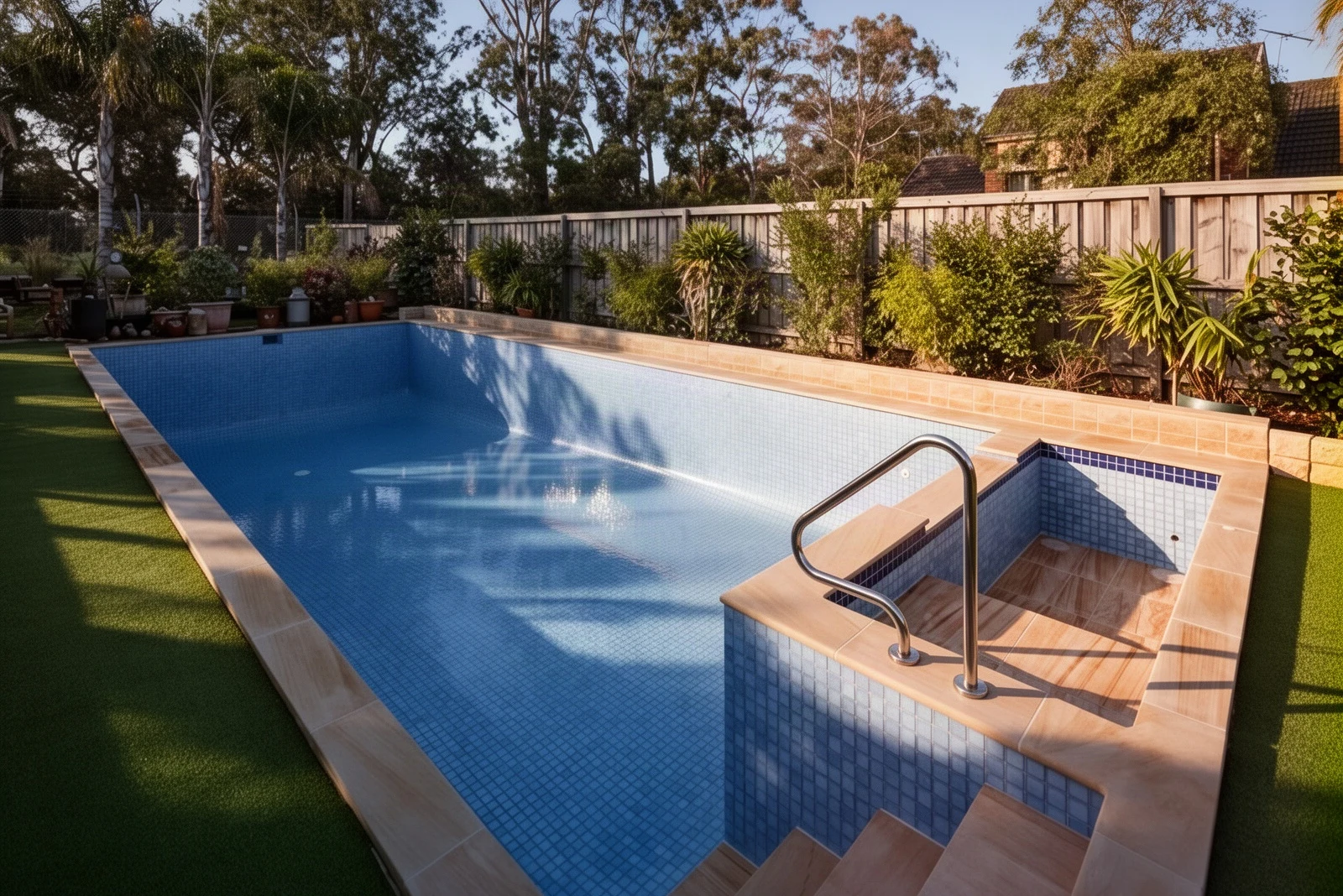
Out of repaints, so retiled, with sandstone paving around it.
Eagle Rock

Grey tile across pool and spa, seen from the air.
La Cañada Flintridge

Collected from customers on the routes we run every week.
Raymond K.Verified review
Local Guide · 52 reviews · 26 photos
20 November 2025
Karen V.Verified review
15 August 2026
Mike T.Verified review
8 July 2026
Diane F.Verified review
6 reviews · 2 photos
6 January 2025
Mark H.Verified review
Local Guide · 42 reviews · 18 photos
3 September 2025

Linda R.Verified review
4 reviews
25 May 2026
Kevin B.Verified review
15 December 2025
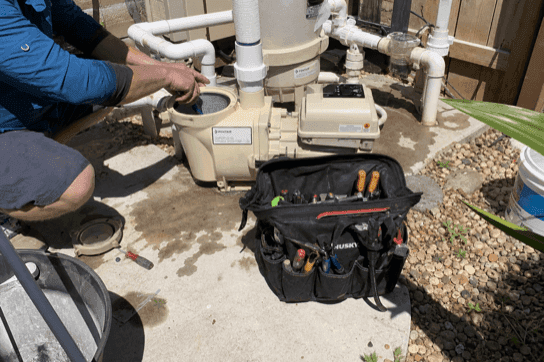
Jason T.Verified review
25 February 2026
Great company. Always on time, pool looks amazing and communication is easy. Highly recommend.
Tell us what the pool needs, how big it is and your ZIP — and a price the same day.
Rewards
$100 for every friend you send us, up to two. No code, no form — they call and mention your name.

$100 credit
For every friend who calls and mentions your name
Up to two referrals, $200 in total. The name must come up on the first call. Spend it on any service.
20% off one-time work
For weekly maintenance members
Green-to-clean, acid wash, plaster start-up and repair labor, plus priority on the schedule.
Where we work
Crews leave from Studio City every morning, across the Foothills and the neighborhoods next to them.
Office · Studio City
The clock starts when the plasterer leaves and the pool begins filling. That is the day to call, not the second week.
4121 Radford Ave, Ste. #214, Studio City, CA 91604Written for Foothill and Valley homeowners.

The decisions that are expensive to change afterwards.

Water has no colour of its own — the interior gives it one.

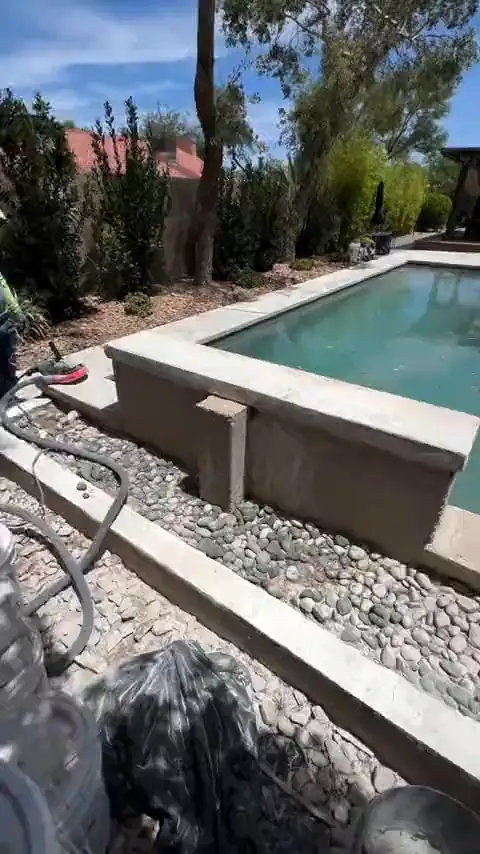
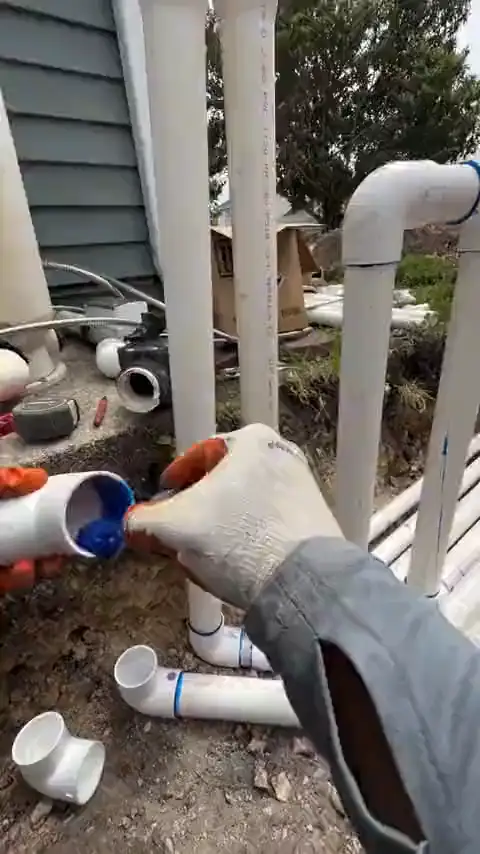
From the truck
Nothing staged, nothing bought from a stock library — the same work, filmed while it happened.


It is less forgiving, and the difference shows in the first month. Coloured pool plaster carries pigment through the whole layer, so anything that etches or clouds the surface — low pH, a brush missed for two days, calcium falling out of solution — leaves a mark that reads as a patch rather than as general wear. The start-up is the same procedure done more carefully: brushed daily, tested daily, and nothing dropped into the water undissolved.
A plaster patch holds where the damage is local and structural — a spall by a return, a chipped step edge, a hole left by a removed fitting. It will not disappear. New plaster against cured plaster is always a visible repair, because the old surface has had years of sun and chemistry and the patch has had none. Worth doing to stop water reaching the shell and to get another few seasons; not worth doing to make the pool look new.
Fourteen days. The pool looks ready long before that, which is exactly why the rule gets broken. Swimming in the first two weeks stirs settled plaster dust across a soft surface and knocks the chemistry off at the point in the cure when it matters most.
After 28 days, once the cure is complete. Until then the pool runs as a chlorine pool and the salt system stays off. The cell is checked at the changeover; if it needs attention, that is salt system work rather than start-up work.
Because it sheds calcium every day of that first week. Brushing lifts the loose material so the filter removes it. Skip a day and it settles and bonds, and what was dust becomes texture that brushing will no longer lift.
In principle, yes: a reliable test kit, a daily hour for a week, the right brush and vacuum head, and the willingness to keep going through days eight to twenty-eight when the pool already looks finished. Most people manage week one and stop.
$595 up to 25,000 gallons, $695 from 25,000 to 40,000, and from $795 above that, with an attached spa adding $75. That is the whole twenty-eight day programme, not a price per visit. Weekly maintenance customers take 20% off.
Twenty-eight days, and the curve is steep at the front: most of the calcium the surface will ever shed comes off in the first week, which is why that week is brushed daily and tested daily. The pool looks finished around day ten and is still curing behind that. Fourteen days before anyone swims, twenty-eight before salt goes in or a wheeled cleaner goes back on the floor.
Start the fill the day the plasterer leaves and do not stop it. A hose run into the deep end with a cloth over the end keeps it from cutting the soft surface, and a fill paused halfway leaves a permanent ring at the waterline. After that the pump runs continuously until the plaster dust is out of the water, usually three to seven days, the surface is brushed daily and twice a day while the shedding is heaviest, and nobody gets in. The heater stays off until the water is clear.
Not in the first couple of days, and never with granular shock tipped in dry. Chlorine waits roughly 48 hours, goes in liquid and pre-diluted, and tablets do not sit in a floater parked against a wall. Anything undissolved that comes to rest on soft plaster burns a mark that stays for the life of the finish. The same rule covers acid: pre-diluted and poured into a running return, never straight down the wall.
Cleaning, recovery, repair and renovation across Los Angeles.
A replaster is the moment tired equipment stops being ignorable
Tell us the size of the pool and whether there is a spa, and we will tell you which row you are in.