
Pool tiling
Rust repair and full tiling
Hollow render and rust cut out, then the whole shell tiled.
Glendale
Diagnostics
A quarter of an inch a day is the weather. An inch a day is a leak. About 320 gallons a day on a 16×32 ft pool. The bucket test tells you which one you have in twenty-four hours.

Licensed, insured and family-owned


Leak or evaporation
Faster with the pump running points at the pressure side; faster with it off, at the suction lines or the shell; the same either way is structural. Until the pad is ruled out nothing underground is worth testing — a leak found there is an ordinary equipment repair, and one crack in sound plaster is a patch, while a crazed hollow shell is a case for resurfacing.
Every leaked gallon takes chlorine, acid, stabilizer and calcium with it, so the pool chases balance permanently: how weekly service reads that. And do not keep restarting a pump that will not prime — running dry melts its own wet end in under an hour, and what that costs is a new pump.
Pool Care LA is R R Pools, California contractor licence #970493, classifications C-53 and C-61/D-35. Verify it at cslb.ca.gov, and see what that means for the bill.
Where pools actually leak
Checked in the order things are cheapest to be wrong, not the order easiest to bill.
What it costs, said plainly
An honest number depends on how many lines have to be isolated and tested, and on what has to be opened at the end.
The crew
Four of us. The same faces every week, not whoever was free that morning.


The same crews open the decks
Hollow render and rust cut out, then the whole shell tiled.
Glendale
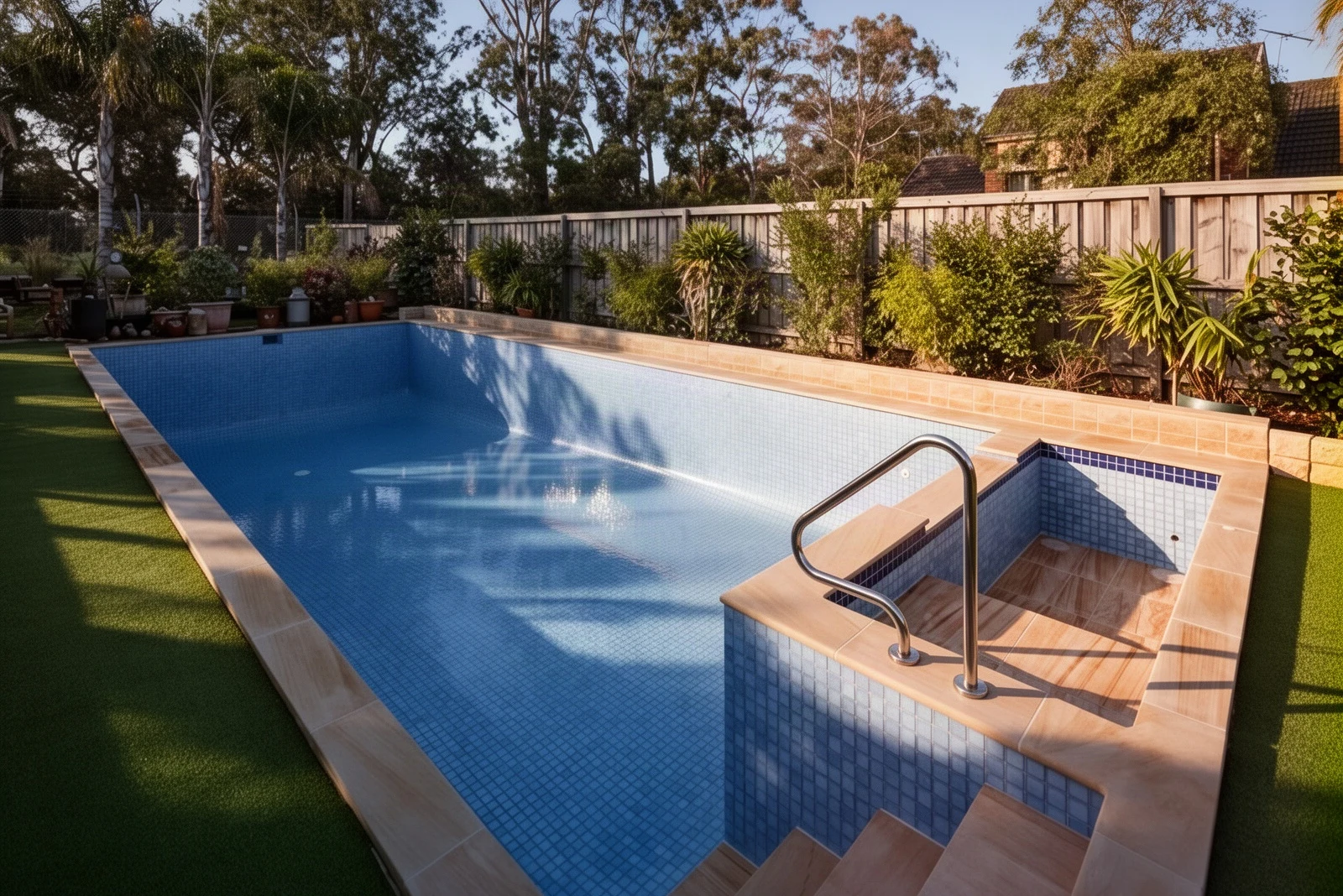
Out of repaints, so retiled, with sandstone paving around it.
Eagle Rock

Grey tile across pool and spa, seen from the air.
La Cañada Flintridge

Collected from customers on the routes we run every week.
Amanda V.Verified review
5 December 2024
Noticed my pool level dropping faster than normal. They checked the system and found the issue before it became a bigger problem. Glad we called when we did.
Patricia N.Verified review
7 April 2025

Mark H.Verified review
Local Guide · 42 reviews · 18 photos
3 September 2025

Linda R.Verified review
4 reviews
25 May 2026
Kevin B.Verified review
15 December 2025
Jason T.Verified review
25 February 2026
Great company. Always on time, pool looks amazing and communication is easy. Highly recommend.
Ashley P.Verified review
11 reviews
4 March 2026
I don't usually leave reviews but these guys deserve it. My pool was a mess and I was tired of trying to fix the chemicals myself. They came out and took care of everything. Water is clear now and I don't have to worry anymore.
Thomas W.Verified review
Local Guide · 27 reviews · 9 photos
10 February 2025
Tell us what the pool needs, how big it is and your ZIP — and a price the same day.
Rewards
$100 for every friend you send us, up to two. No code, no form — they call and mention your name.

$100 credit
For every friend who calls and mentions your name
Up to two referrals, $200 in total. The name must come up on the first call. Spend it on any service.
20% off one-time work
For weekly maintenance members
Green-to-clean, acid wash, plaster start-up and repair labor, plus priority on the schedule.
Where we work
Crews leave from Studio City every morning, across the Foothills and the neighborhoods next to them.
Office · Studio City
Tell us the drop with the pump on, the drop with it off, and the depth the level stops at.
4121 Radford Ave, Ste. #214, Studio City, CA 91604Written for Foothill and Valley homeowners.


What a robot costs to own, where it struggles under trees, and what it never does.

Every degree of heat costs money and changes the chemistry.
Finding it
Nothing staged, nothing bought from a stock library — the same work, filmed while it happened.


Both, and usually in the same visit. Leak detection and leak repair get separated by companies that only own the listening gear, and the result is a report and a second contractor. A fitting, a light conduit, a skimmer throat or a length of accessible pipe is fixed while the pool is already down. What genuinely needs a second visit is a shell crack that wants the water lower, or a line under a deck that has to be cut and re-run. The repair side is set out on the leak repair page.
It leaks faster and shows sooner, because the volume is small and the plumbing runs hot. A jacuzzi that empties overnight while the pool holds level points at the spa side alone: the blower line, a jet fitting or the spillway. Heat is the reason spa leaks cluster at joints — the pipe expands, the joint works, and the crack opens at the temperature it will never show at when cold, so the test has to be run with the heater on.
Checking the pad costs nothing in our service area, and it stays free if you do not go ahead. Underground work — pressure testing, electronic location, excavation — is quoted separately, because the honest figure depends on how many lines must be tested and what has to be opened at the end.
Two bucket tests and a mark on the tile get you most of the way. Faster loss with the pump running points at the returns; faster with it off, at the suction lines or the shell; the same either way is structural. If the level falls, stops dead and holds, the leak is at that depth — just below the light is the niche, at the skimmer mouth is the throat.
Because it is leaking. An inch a day is roughly four times normal Los Angeles evaporation, about 320 gallons a day on a 16×32 ft pool. Check the pad with the pump running and then off before assuming it is underground.
It depends how long it took. At the quarter-inch-a-day rate ordinary here, evaporation alone accounts for nearly two inches a week, so two inches across a week is unremarkable. Two inches in a day is not.
Usually evaporation underestimated on a windy, unshaded pool; splash-out; a backwash valve weeping to waste; an autofill left running during the test; or a pressure-side leak, which a pump-off test cannot show because it only leaks while the pump pushes.
Yes, and there is usually a choice. Once pressure testing identifies the failing line and acoustic location narrows it to a point, the deck is opened as a small patch and that section repaired — or the run is abandoned and rerouted. We agree the approach and the price first.
Autumn stops hiding them. A pool losing half an inch a day to a Los Angeles summer can be losing another quarter through a crack and still look normal in July. Then the nights cool, evaporation falls, and the leak has not changed — the camouflage has. Autumn also brings the summer water bill.
No. Finding it is bucket tests, dye, pressure testing and acoustic listening, and all of that happens with the deck where it is. Concrete gets opened for the repair, not for the diagnosis — and only after the testing has narrowed a line to a point, so what comes up is a patch rather than a trench. Where that patch goes, and what it costs, is agreed before anything is cut.
The free part stays free, and the paid part is agreed before it starts. Checking the pad costs nothing in our service area whatever it shows, and underground testing is quoted first, so nobody runs up a bill hunting. A fair number of calls end with an answer rather than a leak: a hot windy week, an autofill left on through the test, a backwash valve weeping to waste. That is a result too, and it is cheaper than the repair you were bracing for.
Yes, and it usually gets you a better answer. The same number takes texts: send the equipment pad, the tile line with your dated pencil mark, and the two figures from the bucket test — the drop with the pump on and the drop with it off. That is often enough to say whether this is a pad leak or an underground one before anyone drives out, and it decides what gets loaded on the truck.
Cleaning, recovery, repair and renovation across Los Angeles.
Family owned, based in Studio City
The drop with the pump on, the drop with it off, and the depth the level stops at.