

Water
Hot tub maintenance in LA
Attached spa or stand-alone tub, spa water numbers, why chlorine vanishes after a soak, filter rinses and when to drain.
Article
Calcium only leaves a pool with the water it is dissolved in. In Los Angeles the water you refill with brings calcium of its own, so the first number to know is the one coming out of your hose.
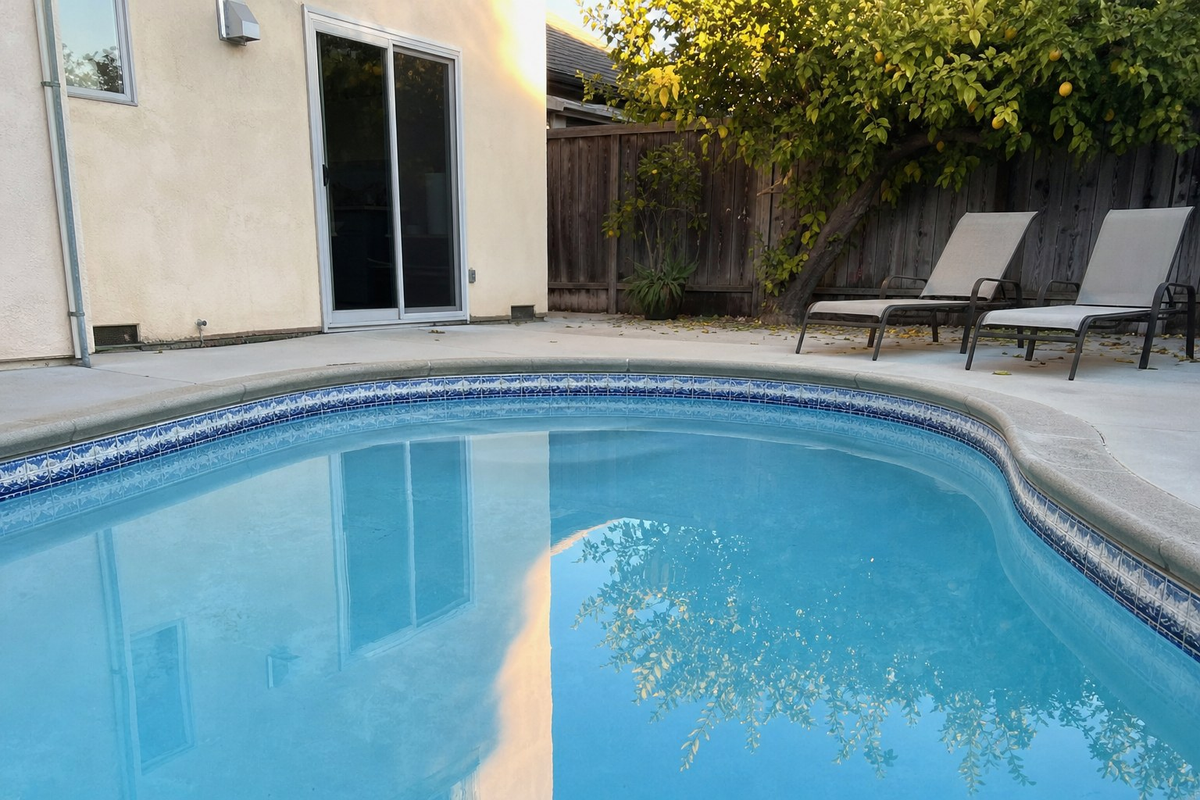
Calcium hardness is the one reading in a pool that goes only one way on its own. Water evaporates, the calcium stays behind, and every top-off adds more. The target for a plaster pool is 200 to 400 ppm, set out with the other four numbers on our pool chemistry page. This page is about what to do once the test says you are outside it.
Bottles sold as hardness reducers bind calcium or hold it in solution so it does not settle as scale. That helps the tile. Your kit, though, will read about the same afterwards, because the calcium is still in the pool. The only way to bring the number down is to take out hard water and put in softer water.
Here is the catch. LADWP blends water from the Eastern Sierra aqueduct, local wells and imported supply, and the mix changes by neighborhood and by season. So the water you refill with is never zero. Fill a clean glass from the hose and run the same calcium test you use on the pool. Write it down. That number is the floor: no amount of draining gets the pool below it.
Take the pool reading minus your target, and divide by the pool reading minus the hose reading. That is the share of the pool to replace. It is a different sum from the one on our stabilizer page, where the tap water adds nothing and the math is simpler.
The last line is why some pools in harder parts of town are not worth draining for calcium alone. When the hose reads close to your target, you replace most of the pool to gain very little, and the summer pushes it back up within a season or two.
In Los Angeles County pool water goes to the sewer clean-out on your property, never to the street, and the water level comes down in stages rather than all at once. Our guide on draining a pool covers the clean-out, the pump and when an empty shell is risky. What changes for calcium:
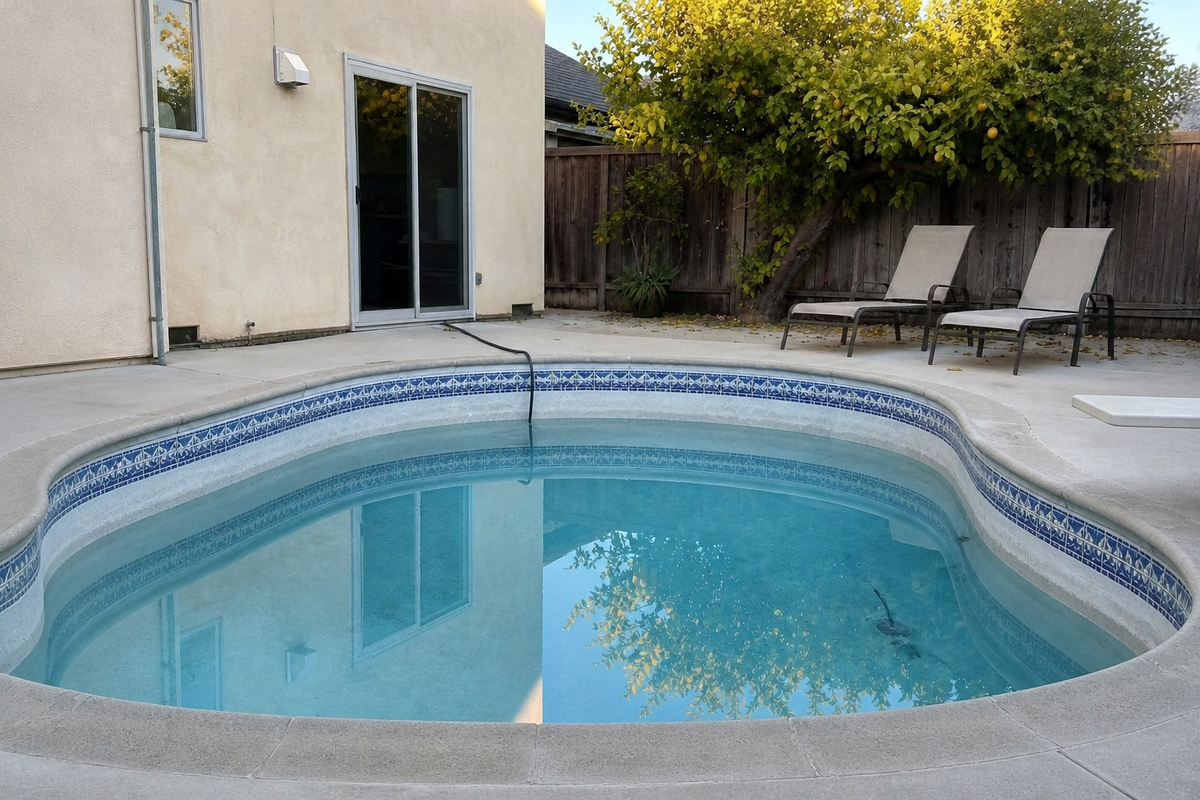
November through March is the comfortable window. The sun is low, exposed plaster does not bake while the level is down, and winter rain does a little of the diluting for free. A partial drain in August asks for trouble on dark plaster and wastes water at the worst time of year.
A reading of 450 or 500 is not an emergency. Scale forms when calcium, pH, alkalinity and temperature all lean the same way, which is what pool techs call the saturation index. Keep pH at 7.4 to 7.6 and alkalinity toward the low end of its range, and a lot of LA pools sit above 400 for years with only some crust at the waterline to show for it.
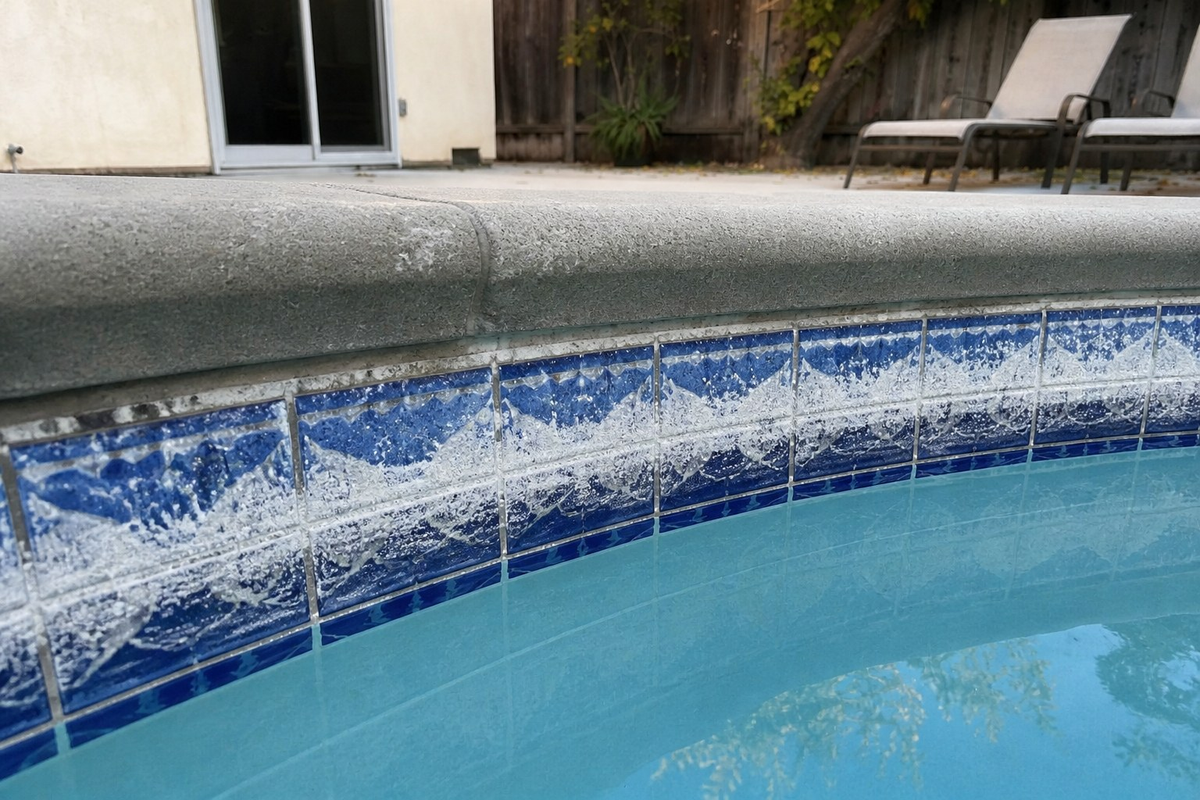
Three things change that picture. A salt cell scales up fast in hard water, and the saltwater maintenance guide explains how to check its plates. A heater runs hot water through its exchanger, where scale forms first. And granular shock adds calcium with every dose, so switching to liquid chlorine stops one source cold. White crust that is already on the tile is a tile cleaning job. Hard white bumps on the steps are something else again, and our page on calcium nodules explains why.
Mobile reverse osmosis is a trailer that pumps the pool water through membranes and returns most of it softened, without emptying the shell. It makes sense when the hose water is nearly as hard as the pool, or when watering rules restrict a refill. Listings in Los Angeles search results in November 2026 put a single treatment for a backyard pool at roughly $350 to $800. Those are other companies' figures, not ours, and pool size moves them more than anything.
Low calcium is rare in an older LA pool, but it happens after reverse osmosis, after a fresh fill in a softer neighborhood, and in a spa that gets drained and refilled every few months. Water under 200 ppm draws calcium out of plaster and grout and leaves the surface rough. Fresh plaster is held at 200 to 400 ppm through its first four weeks on our plaster start-up for this reason.
Doing it yourself costs the refill water and a pump rental. LADWP bills water in HCF, which is 748 gallons, so replacing half of a 20,000-gallon pool runs through about 13 HCF on your bill, plus the sewer charge that goes with it. A bag of calcium chloride covers a low reading. On our weekly service calcium is read on every visit, and the plan runs from $159 a month, chemicals included, as the price list shows.
Send us the pool reading, the hose reading and the pool's size, and we will tell you whether it is worth a drain at all. Write to us here or ring (818) 740-6099. Standard diagnosis is free inside our service area.
Evaporation and hard refill water. Each inch the pool loses leaves its calcium behind, and the hose replaces the water with more. Granular calcium hypochlorite shock and some tablets add a little more each week.
Calcium hypochlorite does, since calcium is half its name. Over a summer of weekly doses the gain shows on the test. Liquid chlorine and lithium shock add none.
No. Baking soda raises total alkalinity and nudges pH up. It can still make scale worse in hard water, because higher alkalinity and pH push calcium that is already there out of solution.
The same calcium chloride, in a much smaller dose, because a spa holds a few hundred gallons. Dissolve it in a cup of spa water, add it with the jets running and retest after an hour.
Only with reverse osmosis, which filters the water on site. Reducer products keep calcium from scaling but leave the reading where it was.
Send the pool reading, a reading from your hose and the pool's size. We will tell you how much water a drain would take and whether it is worth it. Or call (818) 740-6099
Written for Foothill and Valley homeowners.
Attached spa or stand-alone tub, spa water numbers, why chlorine vanishes after a soak, filter rinses and when to drain.
Boric acid or borax, how many pounds for 30–50 ppm, how to add it and when borates aren't worth it.
Why the reading climbs in autumn, why a test lies above 10 ppm, and how to bring it down with sun, neutralizer or a partial drain.
Los Angeles and the Valley
We read calcium hardness on every weekly visit and tell you when a partial drain is worth the water. Standard diagnosis is free in our service area.