
Weekly maintenance
A settled day each week, the full panel, net and vacuum, brushing, baskets and the whole pad inspected. Ask which days still have room here.
Flat lots, smaller pools, and a lot of owners who do it themselves — easy to reach and easy to underestimate.

Licensed, insured and family-owned


Most calls start here
Four failures, and the first two are the ones self-maintained pools run into.
Chlorine that tests fine and does nothing
Years of stabilized tablets raise cyanuric acid a little at a time, and it never leaves. Past a point the chlorine is locked: the reading looks correct while algae grows anyway.
A filter nobody has opened in years
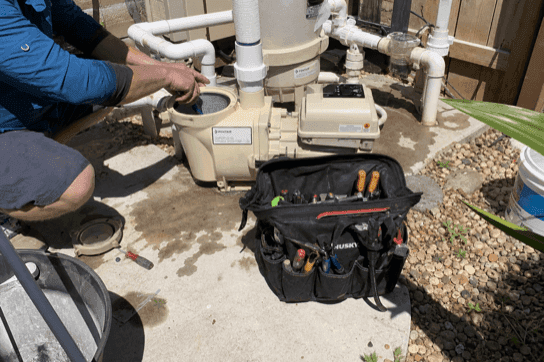
The cheapest thing on the pad and the most ignored. A loaded cartridge cuts flow until the water clouds, the heater will not fire and the pump works against a restriction.
Filter cleaningAn old single-speed pump doing the whole job at full power
The largest electrical load on the property, on a time clock set for a different decade. Manufacturers put the saving from a variable-speed unit at up to $1,100 a year.
Pump repairWater that clouds up every time the wind blows
Open flat lots collect dust and pollen, and irrigation overspray adds phosphate. Fine particles pass through a tired filter and stay in suspension. That is filtration, not chlorine.
Why North Hollywood is different
North Hollywood pools are mostly modest, mostly older, and sit on level ground in full sun. Less water means less buffer: the heat wave that nudges a 35,000-gallon pool moves a 12,000-gallon one twice as far in the same week.
pH climbs, chlorine burns off, and the water goes cloudy with nothing obviously wrong. Small pools are not less work; they are less forgiving.
The flats around Lankershim and Magnolia are open and largely unshaded, and ultraviolet light destroys unprotected chlorine within hours. From June to September the question is not how much chlorine went in but how much survived the afternoon. What weekly service costs is on one page, with no form.
 After
After Before
What we do in 91601
We run routes rather than a radius, and North Hollywood sits close to our Studio City office.
A settled day each week, the full panel, net and vacuum, brushing, baskets and the whole pad inspected. Ask which days still have room here.

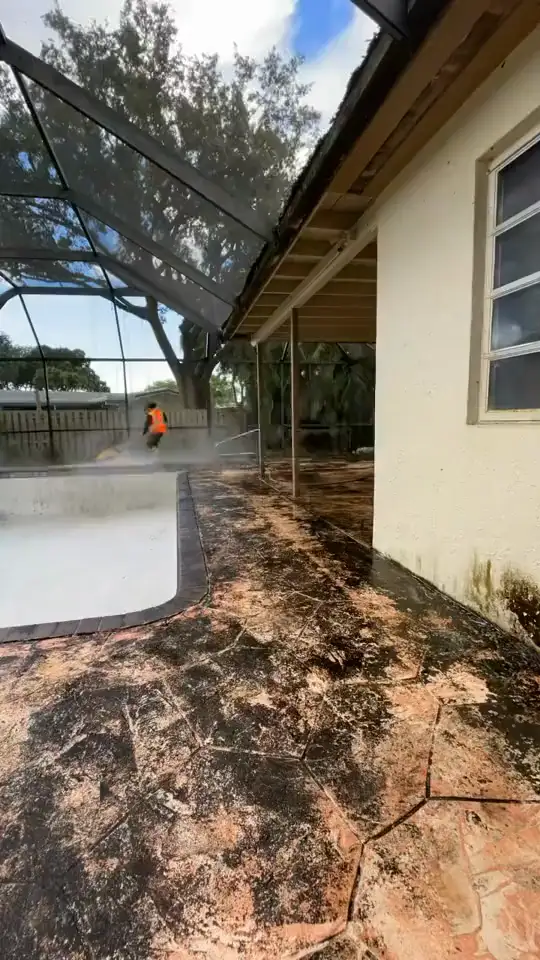
For a pool that got away over a hot month. No draining, swimmable in about two days, filter cleaned two or three times along the way.

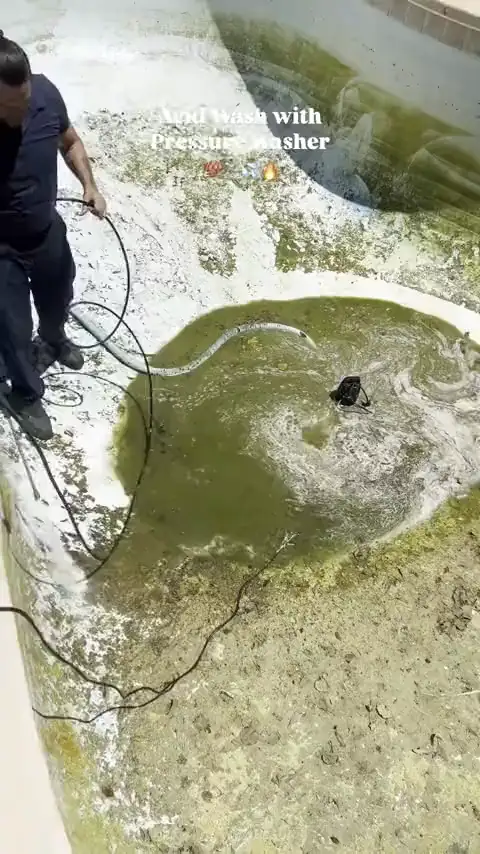
For older plaster that has stained past brushing. It spends a layer of finish, so we check there is at least half an inch left to spend.

Pumps, filters, heaters, salt systems, plumbing, electrical components, lights and time clocks — diagnosed before anything is replaced.

Four weeks after a resurface: daily nylon brushing, calcium hardness 200–400 ppm, pH 7.2–7.6, no salt for 28 days.
Pricing
Volume decides chemical demand, so it decides the price. Typical homes land between $179 and $249 a month. Chemicals included, no minimum contract.


Prices as of August 2026, for a pool in normal condition.
One-time work
Quoted on the job, because nobody can price a green pool from a web form.
If you have been maintaining it yourself
Doing your own pool is entirely reasonable. These are the parts that quietly cost money.
The crew
Four of us. The same faces every week, not whoever was free that morning.


A North Hollywood job, start to finish
A neglected pool backing onto open ground: cleaned out, repaired and resurfaced in a bright ultra-smooth pebble.
A bright smooth pebble interior, a warm terracotta waterline band, the original coping saved, and screening along the back fence.
Nearby, and on the same routes
Studio City, Burbank and Sherman Oaks share the days that serve North Hollywood.

Hollow render and rust cut out, then the whole shell tiled.
Glendale
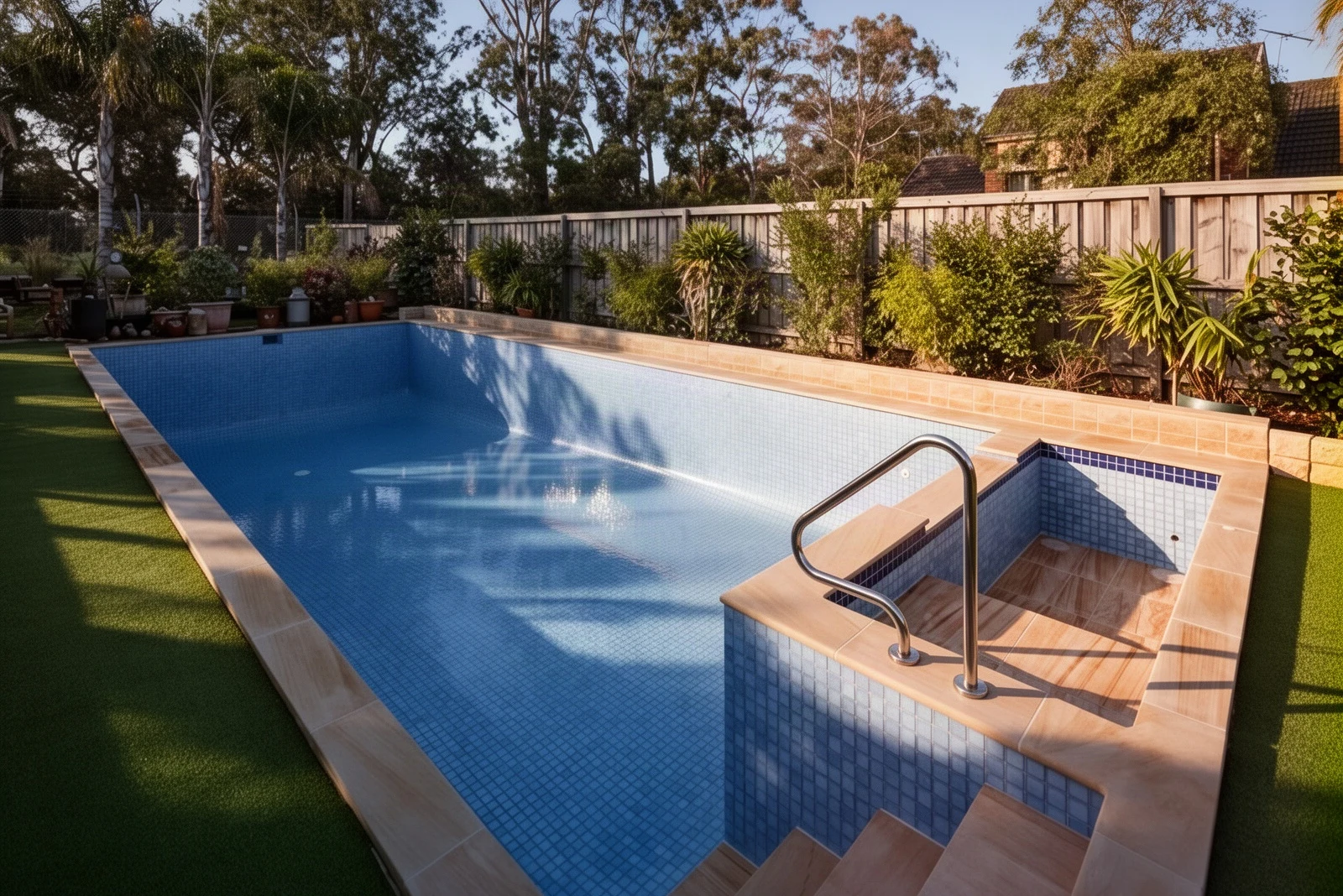
Out of repaints, so retiled, with sandstone paving around it.
Eagle Rock

Grey tile across pool and spa, seen from the air.
La Cañada Flintridge

Ashley P.
11 reviews
4 March 2026
Mark H.
Local Guide · 42 reviews · 18 photos
3 September 2025

Linda R.
4 reviews
25 May 2026
Kevin B.
15 December 2025
Jason T.
25 February 2026
Great company. Always on time, pool looks amazing and communication is easy. Highly recommend.
Thomas W.
Local Guide · 27 reviews · 9 photos
10 February 2025
Rachel M.
17 October 2025
We thought we needed a completely new pool system. Turns out it was just a few issues with the pump and filter. They saved us a lot of money by fixing what actually needed fixing.
Jennifer C.
Local Guide · 15 reviews · 4 photos
7 September 2025
Tell us what the pool needs, how big it is and your ZIP — and a price the same day.
Rewards
$100 for every friend you send us, up to two. No code, no form — they call and mention your name.

$100 credit
For every friend who calls and mentions your name
Up to two referrals, $200 in total. The name must come up on the first call. Spend it on any service.
20% off one-time work
For weekly maintenance members
Green-to-clean, acid wash, plaster start-up and repair labor, plus priority on the schedule.
Where we work
Crews leave from Studio City every morning. Open any area for what is different there.

Send your ZIP or cross streets. We come back the same day with the day we would be there — and what weekly service would cost on your pool.
Or call (818) 740-6099
Tell us how long since the filter was opened and what the water is doing.
Written for Foothill and Valley homeowners.

Every degree of heat costs money and changes the chemistry.

Cleaning is what you see. Management decides your repair bills.

Not stock footage
Filmed on the North Hollywood route and the streets next to it. Nothing staged, nothing bought from a stock library.
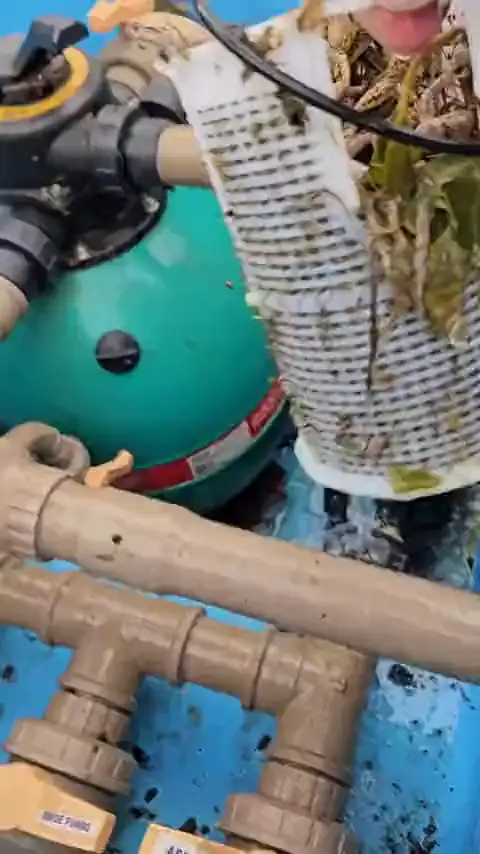

Mostly the equipment, not the water. Owners who do their own pool usually keep the chemistry acceptable and let the pad drift — the filter goes years between cleanings, the time clock never changes with the season, faults are found when something stops. A weekly route costs about what one algae recovery costs.
Almost always locked chlorine from high cyanuric acid — the classic outcome of tablets in a floater over several summers. The test says chlorine is present; chemically it is not available to kill anything. The other candidate is phosphate feeding algae faster than chlorine can work. Neither shows on a strip.
Usually not. High pressure means the medium is loaded, which is what a filter is supposed to do — it needs pulling apart and washing. Cartridges are replaced when the pleats collapse or tear, not because the gauge reads high. If pressure stays high straight after a clean, the problem is elsewhere.
Yes, but the recovery comes first and the weekly route starts after. We do not sell one-time routine cleanings — a pool in that state usually needs a green-to-clean or an acid wash, which are separate jobs priced on the work rather than on the month.
Weekly service starts at $159 a month for a pool up to 15,000 gallons and runs to $249 a month for pools over 40,000, with standard chemicals included. Most customers pay between $179 and $249. North Hollywood is priced the same as everywhere else on our routes — the address does not change the number, the pool does. One-time work is quoted on the job: green to clean from $349, acid wash from $749, equipment repair at $175 an hour.
Cleaning, recovery, repair and renovation across Los Angeles.
Next to North Hollywood, and on the same routes
Roughly how many gallons, what is on the pad, and how long since the filter was opened.


